Infrastructure

Budapest Tier III Datacenter and Network

Every VPS Hungary virtual machine and dedicated server runs in a Tier III certified datacenter in Budapest. The location was chosen for two reasons: Hungary sits in the heart of Central Europe, a short network hop from a dozen neighbouring markets, and a Tier III facility provides the redundancy that a hosting business depends on day after day.

This page explains what that infrastructure means in practice. You will find out what Tier III certification guarantees, how Budapest’s position helps latency across Central and Eastern Europe, how our multi-carrier network and 1 Gbps ports are set up, why genuine Hungarian IPv4 addresses with rDNS matter for email and local search, which security layers protect your services, and how hosting inside the European Union supports data residency obligations. Whether you run a single proxy node or a fleet of bare metal machines, the foundation underneath is the same.
Server aisle with redundant power distribution and network racks in a Budapest Tier III datacenter
  • Tier IIIConcurrently maintainable
  • Multi-carrierSeveral upstream ISPs
  • Hungarian IPv4Local geo-location
  • EU hostingGDPR jurisdiction

Tier III Certification: Concurrently Maintainable Infrastructure

Datacenter tiers are a widely used classification for how resilient a facility is. They range from Tier I, essentially a server room with a single path for power and cooling, to Tier IV, a fully fault-tolerant design. Tier III sits in the space most commercial hosting providers aim for: serious redundancy at a cost that keeps services affordable.

Server rack with dedicated machines

Concurrently maintainable

The defining property of Tier III is that the facility is concurrently maintainable. Every component that supports the IT load, from power feeds and UPS units to chillers and pumps, can be taken out of service for planned maintenance or replacement without switching off the servers. Engineers can service a generator, replace a battery string or repair a cooling unit while customer hardware keeps running.

Redundant capacity and distribution paths

To make that possible, a Tier III site provides:

  • N+1 redundancy for critical components, so there is always at least one spare unit beyond what the load requires.
  • Multiple power and cooling distribution paths, with one active and others ready to take over.
  • Dual-powered IT equipment support, letting servers draw power from more than one feed.
  • On-site backup generation with fuel reserves that can carry the facility through extended grid outages.

Why it matters for your server

Most outages in smaller facilities are not caused by catastrophic disasters. They come from routine events: a utility interruption, a failed UPS module, a cooling fault on a hot day, or maintenance that required a shutdown. A Tier III design is built so that none of these needs to take your services offline. That is the physical foundation behind our 99.9% uptime target for both VPS Hungary plans and dedicated servers in Hungary.

Tier III does not remove the need for good practice on your side. Hardware inside a server can still fail and software can still misbehave, so we recommend keeping backups and, for critical services, designing your application to tolerate the loss of a single node. The facility takes care of power, cooling and the building; your architecture takes care of the rest.

Budapest as a Low-Latency Hub for Central and Eastern Europe

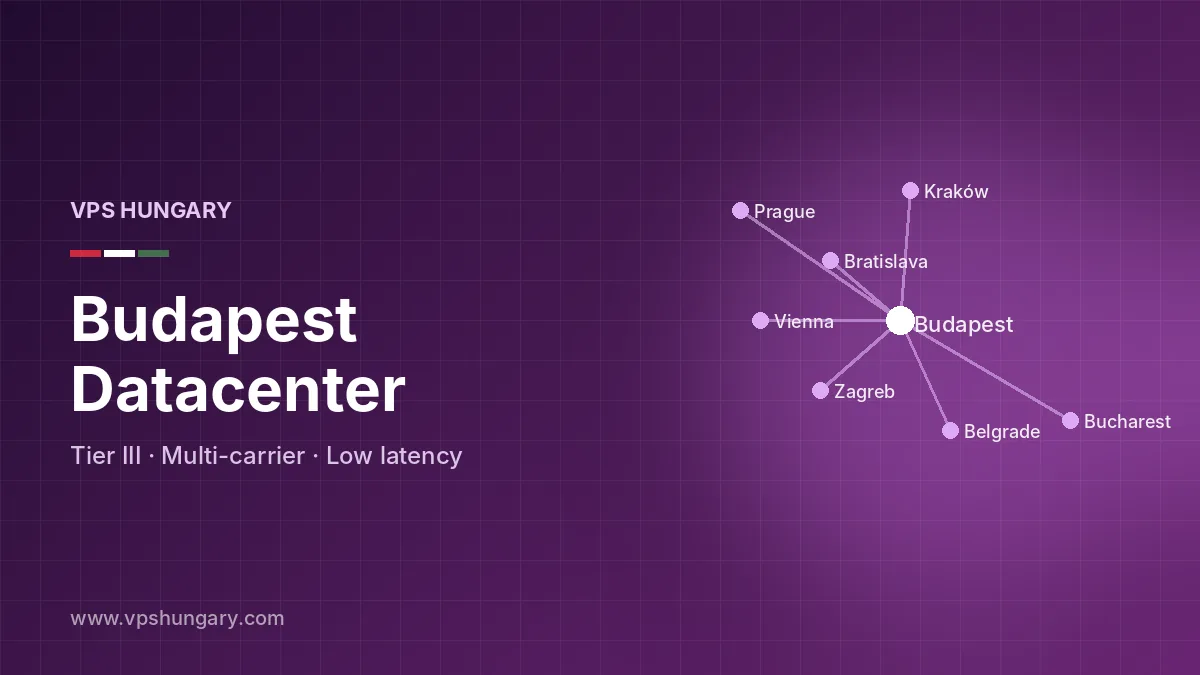
Network latency is governed largely by physical distance and the number of hops between two points. Budapest has an unusually favourable position on both counts. It lies roughly in the middle of the Carpathian Basin, close to the borders of seven countries, and it is one of the main network interconnection points of the region.

Neighbouring markets within easy reach

From our Budapest facility, traffic reaches a wide ring of countries over short, direct routes:

  • Austria and Slovakia – Vienna and Bratislava are only a short distance away, so round trips are typically very short.
  • Romania – Transylvania and western Romania are close, and Bucharest is well connected via regional backbones.
  • Serbia, Croatia and Slovenia – the Western Balkans and the Adriatic coast sit directly to the south.
  • Ukraine, Poland and the Czech Republic – reachable over established Central European routes.
  • Germany, Italy and the wider EU – a short hop to the major Western European exchanges.

Who benefits

A central location helps any workload where responsiveness matters to people spread across several countries. Online shops selling across the region load faster. Game servers can host players from Vienna, Belgrade and Cluj on the same machine with a fair experience for all. Trading bots and financial applications gain from short paths to regional platforms. Remote desktop users in neighbouring countries notice smoother sessions, and a VPN or proxy endpoint in Budapest gives teams in the region a nearby exit point.

A balanced alternative to Western hubs

Many providers place their European capacity in Frankfurt, Amsterdam or London. Those cities are excellent for Western Europe, but users in Bucharest, Zagreb or Kyiv pay a latency penalty for the detour west. Hosting in Budapest shortens that distance while still keeping Western European users well within comfortable response times. For businesses whose audience is mostly Central or Eastern European, it is often the more sensible middle point.

Exact figures depend on each visitor’s own ISP and routing, so we encourage you to test from your own location. If you would like a test address, ask through the contact page.

Map of network routes from Budapest to neighbouring capitalsViennaBratislavaPragueKrakówBucharestBelgradeZagrebLjubljanaBudapest

Multi-Homed Network with 1 Gbps Ports

A datacenter is only as useful as its connectivity. Our Budapest network is multi-homed: it connects to several independent upstream ISP carriers rather than relying on one. Routing protocols choose the best available path for each destination and steer traffic around a carrier that has a fault or congestion.

Budapest connected to Carriers, 1 Gbps, Inside, Heavy usesCarriers1 GbpsInsideHeavy usesBudapest

Why multiple carriers matter

  • Resilience. If one upstream suffers a fibre cut or a routing problem, traffic shifts to the others, usually without users noticing.
  • Better routes. Different carriers have different strengths. With several to choose from, traffic to a given network can follow the shortest, least congested path.
  • Capacity headroom. Aggregate bandwidth across several providers absorbs traffic peaks that would saturate a single link.

1 Gbps ports, lightly loaded

Every virtual machine and dedicated server connects at 1 Gbps. The port is shared, but we keep it lightly loaded on purpose so that you see consistent throughput instead of evening slowdowns. VPS plans include unlimited, unmetered bandwidth, and dedicated servers include 5 TB of monthly traffic with more available on request. There are no hidden charges for bandwidth.

Inside the network

An internal firewall separates the hosting network from the outside world, and our edge applies basic filtering against common attacks before traffic reaches your instance. Common ports are open by default, so web, mail, database, VPN, proxy and game traffic all work out of the box. For dedicated server customers who need something specific, such as private links between several machines, custom networking can be arranged on request.

Typical network-heavy uses

The combination of fast ports and diverse upstreams suits workloads that move a lot of data or need stable connectivity: VPN gateways for remote teams, proxy pools with Hungarian exit addresses, software mirrors, media streaming, off-site backup targets and multiplayer game servers. If your bandwidth needs grow, you can move up to a larger VPS plan or to bare metal without leaving the same network, so your routes and IP geolocation stay consistent.

Network issues are handled through 24/7 support tickets in the client area.

Hungarian IPv4 Addresses, rDNS and Email Reputation

Each service comes with genuine Hungarian IPv4 addresses drawn from several ranges. The addresses are registered to Hungary, so geolocation databases, search engines and content services recognise them as Hungarian. Additional IPs are available as a paid add-on if you need separate addresses for different sites, services or virtual machines.

Reverse DNS and PTR records

A forward DNS record maps a hostname to an IP address. A reverse DNS record, stored as a PTR record, does the opposite: it maps an IP address back to a hostname. We allow rDNS/PTR records on request. Open a ticket with the IP address and the hostname you want, for example mail.yourdomain.hu, and we will set it for you.

Why rDNS matters for email

Receiving mail servers use several checks to decide whether a message is legitimate. One of the first is whether the sending IP has a PTR record, and whether that record matches the hostname the server announces. Missing or generic reverse DNS is a common reason for messages being rejected or sent to spam. Getting it right is a basic step for anyone running their own mail server, whether it handles a single domain or hundreds of client mailboxes.

Building a good sending reputation

A correct PTR record is necessary but not sufficient. For reliable delivery we recommend:

  • Publishing an SPF record listing the IPs allowed to send for your domain.
  • Signing outgoing mail with DKIM.
  • Adding a DMARC policy so receivers know how to treat failures.
  • Warming up a new IP gradually rather than sending large volumes on day one.
  • Sending only to recipients who asked for your messages.

A clean network protects everyone

IP reputation is shared across neighbouring addresses, so one spammer can harm others on the same range. That is why our acceptable-use policy strictly forbids spam, and accounts that send it are terminated. Keeping abusers off the network protects the reputation of every customer’s addresses. Details are in our terms of service.

Network Security, DDoS Filtering and Physical Protection

Security in hosting works in layers. Some are our responsibility, some are yours, and the best results come when both are in place. Here is what protects services in our Budapest facility.

Stacked layers: Network edge, Physical site, Your server, Abuse deskAbuse deskYour serverPhysical siteNetwork edge

Network-level protection

  • Internal firewall. The hosting network sits behind an internal firewall that filters traffic between the outside world and customer segments.
  • Basic DDoS protection. Common volumetric and protocol attacks are filtered at the network edge, which keeps routine floods from taking services offline. This is baseline protection rather than a specialised mitigation service, so high-profile targets should plan additional measures such as an upstream filtering proxy.
  • Intrusion protection. Network monitoring detects and blocks known malicious patterns, such as large-scale scanning, before they reach individual servers.

Physical security

A Tier III facility is built with physical protection in mind. Access to the building and the server halls is restricted to authorised staff, controlled by entry systems and monitored by surveillance. Visitors are registered and escorted. Fire detection and suppression systems are designed to protect equipment, and environmental monitoring watches temperature and humidity around the clock. These measures protect against theft, tampering and environmental damage to the hardware your data lives on.

Your side of the line

Our services are unmanaged by default, which means you control the operating system and everything installed on it. Good habits make a big difference:

  • Keep the OS and applications updated.
  • Use SSH keys instead of passwords on Linux, and strong unique passwords for RDP on Windows.
  • Close ports you do not use with a host firewall such as firewalld, ufw or Windows Firewall.
  • Run services under unprivileged accounts where possible.
  • Keep backups off the server and test that you can restore them.

If you prefer not to handle this yourself, paid management is available and covers updates, hardening and monitoring.

Abuse handling

We act quickly on abuse reports. Accounts used for spam, attacks or illegal content are terminated, which keeps the network clean and protects every customer’s IP reputation. Report abuse or a security concern through a support ticket.

Local SEO and Geo-Targeting with a Hungarian IP

Where your server lives can influence how your website is found and how it behaves for visitors. Hosting in Budapest on a Hungarian IP address brings several practical benefits for anyone targeting Hungary or the surrounding region.

Globe with a Budapest location pinhu · BudapestIPv4 geo: HU

Faster pages, better experience

Search engines take page experience into account, and load speed is part of that. Serving pages from a nearby datacenter cuts round-trip time for every request, which helps time to first byte and overall load times for Hungarian and Central European visitors. Faster pages also tend to keep people on the site longer, which matters more than any single ranking signal.

Geographic signals

Search engines use many signals to understand which country a site targets: the country-code domain such as .hu, the language of the content, local addresses and links from local sites, and settings in webmaster tools. Server location is a minor signal compared with those, but a Hungarian IP is consistent with the rest of the picture, especially for sites on generic domains such as .com or .eu. Aligning every signal is better than leaving search engines to guess.

Geo-targeted content and services

Many web services adapt content based on the visitor’s IP address. A Hungarian IP lets you:

  • Check how your own site, ads and search results appear to users in Hungary.
  • Access regional versions of services and pricing for testing and market research.
  • Run SEO rank-tracking and monitoring tools that report local, not foreign, results.
  • Operate a VPN or proxy that gives your team a reliable Hungarian presence while travelling.

Use of a Hungarian IP must, of course, respect the terms of the services you access and local law.

Choosing the right plan

A single business website or a small online shop usually runs comfortably on a small VPS. Agencies managing many local client sites often prefer a larger VPS with a control panel, or a dedicated server when the portfolio grows. If your audience also spans Austria, Slovakia, Romania or the Balkans, Budapest gives you a central position for all of them from one location. You can compare operating system options on the Linux VPS and Windows VPS pages and upgrade to a higher plan as traffic grows.

GDPR, Compliance and EU Data Residency in Hungary

Hungary is a member state of the European Union, and our Budapest datacenter is located entirely within EU territory. For businesses that handle personal data about European residents, that location simplifies a number of compliance questions.

  • Data stays in the EU

    The General Data Protection Regulation (GDPR) applies throughout the EU and sets common rules for how personal data is collected, stored and processed. Transfers of personal data to countries outside the European Economic Area are subject to additional conditions. When your servers are in Budapest, the data stored on them remains inside the EU, which removes one layer of complexity from your compliance work and makes it easier to answer customer and auditor questions about where data is held.

  • Shared responsibility

    Hosting in the EU is a helpful starting point, not a complete compliance programme. Under GDPR you, as the operator of the website or application, typically act as the data controller and decide what data you collect and why. That means you remain responsible for:

    • Having a lawful basis for processing and a clear privacy notice.
    • Securing your server and applications, including updates, access control and encryption where appropriate.
    • Keeping backups and being able to restore data after an incident.
    • Responding to data subject requests such as access or deletion.
    • Choosing where backups and replicas are stored, ideally also within the EU.

    Because our services are unmanaged by default, you have full control over these measures. Paid management and backup services are available if you want assistance. This page provides general information, not legal advice; for specific obligations, consult a qualified adviser.

  • How we handle your account data

    We collect only the information needed to provide and bill your services. Our privacy policy explains what we store, how it is used and how you can contact us about it, and our terms of service set out acceptable use.

  • Industries that value EU hosting

    E-commerce shops, SaaS providers, agencies hosting client data, healthcare and education projects, and any organisation whose customers ask where their data lives all benefit from a clear EU location. Combined with Tier III infrastructure and a multi-carrier network, Budapest offers a dependable base for regulated and privacy-conscious workloads. Questions? Email info@vpshungary.com.

Questions buyers ask

What does Tier III certification mean?

Tier III means the datacenter is concurrently maintainable. Power, cooling and their distribution paths have redundant components, so any single piece of equipment can be serviced or replaced without shutting down customer servers. It also includes backup generators and UPS systems. This design underpins our 99.9% uptime target for VPS and dedicated servers in Budapest.

Why host in Budapest instead of Frankfurt or Amsterdam?

Budapest sits in the centre of the region, close to Austria, Slovakia, Romania, Serbia, Croatia and Ukraine. If your visitors are mostly in Central or Eastern Europe, routes from Budapest are shorter than from Western hubs, which means quicker page loads and smoother real-time applications, while Western European users still get comfortable response times.

How many network carriers does the datacenter use?

The network is multi-homed, connected to several independent upstream ISP carriers. Routing picks the best available path for each destination and automatically avoids a carrier with a fault or congestion. This improves both resilience and route quality. Every VPS and dedicated server connects to this network through a lightly loaded 1 Gbps port.

Are the IP addresses really Hungarian?

Yes. Every service receives genuine Hungarian IPv4 addresses from several ranges, registered to Hungary and recognised as Hungarian by geolocation databases. That helps local SEO consistency, regional content testing and VPN or proxy use. Additional IPv4 addresses are available as a paid add-on if you need more than the ones included with your plan.

Can I set reverse DNS (PTR) for my IP?

Yes. rDNS/PTR records are set on request. Open a support ticket with the IP address and the hostname you want, such as mail.example.com, and we will configure it. A matching PTR record is important for mail servers, because many receiving systems reject or flag messages from IPs without proper reverse DNS.

What DDoS protection is included?

All services include basic DDoS and intrusion protection at the network edge, plus an internal firewall. This filters common floods and malicious scanning before they reach your server. It is baseline protection rather than a specialised mitigation service, so high-profile targets should consider an additional upstream filtering layer and harden their own server configuration.

Is the datacenter physically secure?

Yes. Access to the facility and server halls is restricted to authorised personnel through controlled entry systems and is monitored by surveillance. Visitors are registered and escorted. Fire detection and suppression, along with continuous environmental monitoring of temperature and humidity, protect the hardware. Together these measures guard against tampering, theft and environmental damage.

Does hosting in Hungary help with GDPR?

Hungary is an EU member, so data stored on our Budapest servers stays within the European Union. That simplifies data residency questions and avoids international transfer issues for the server itself. You still act as the data controller and remain responsible for lawful processing, security, backups and handling data subject requests in your own applications.

Will a Hungarian IP improve my search rankings?

Server location is a minor signal compared with your domain, language, content and local links, but it supports a consistent Hungarian profile. The bigger benefit is speed: serving pages from Budapest reduces load times for local visitors, which improves user experience. It also lets you check local search results and geo-targeted content accurately.

Which services run in the Budapest datacenter?

All VPS Hungary services run there: KVM virtual servers on NVMe SSD in RAID-10 with Linux or Windows, and Intel Xeon dedicated servers from DSH1 to DSH5. Because everything shares the same facility and multi-carrier network, upgrading from a small VPS to a larger plan or to bare metal keeps your location, latency and Hungarian IP geolocation unchanged.

Need help choosing a server?

Our team answers sales and technical tickets around the clock.

Submit a ticket
Submit a ticket